The Genesis: The Hidden Soul of Period Motors
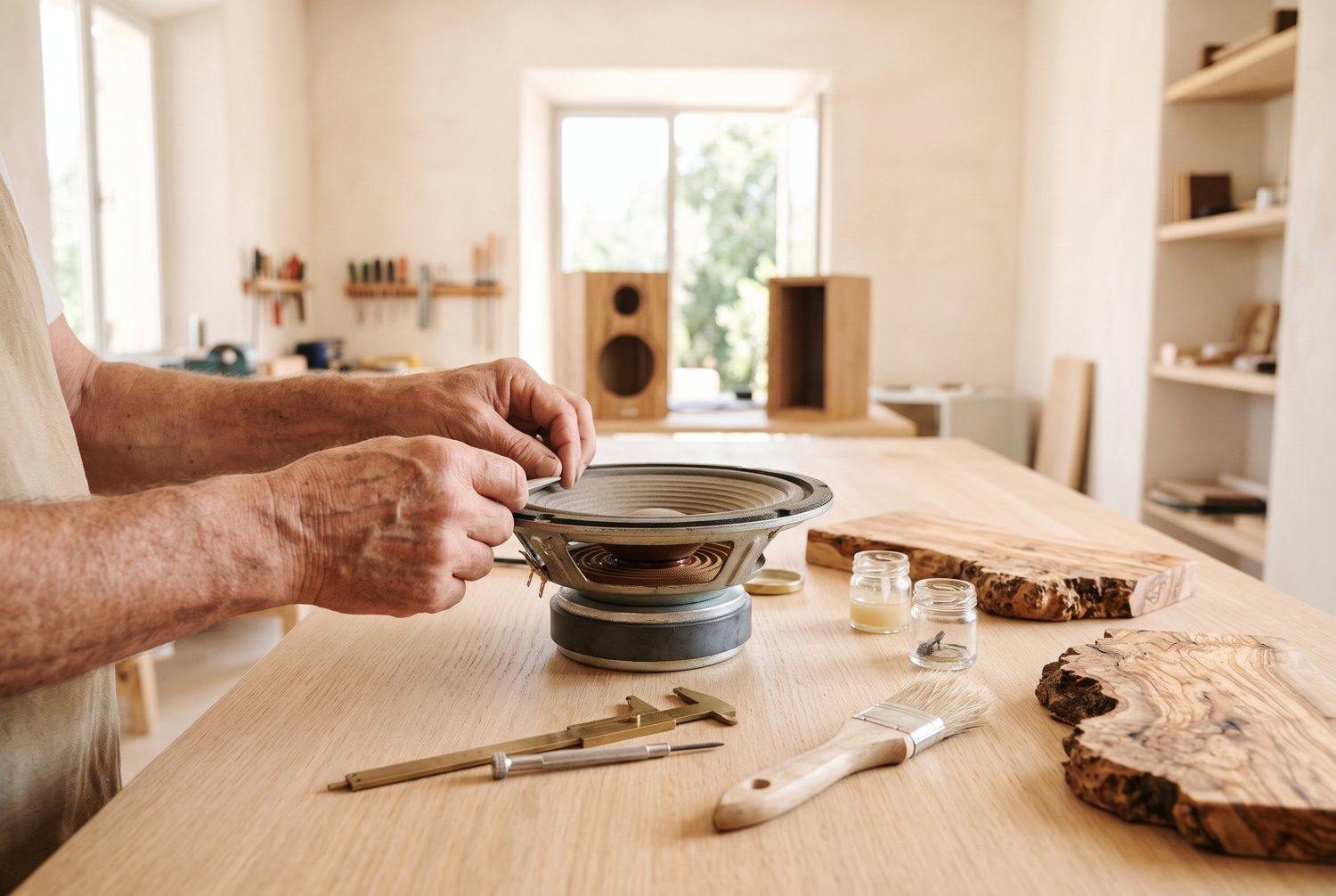
Everything started with a simple passion: giving a second life to forgotten Hi-Fi speakers found in attics, flea markets, and estate sales across Europe. What began as a weekend hobby, carefully dismantling old Grundig, Magnat, and IQ speakers, gradually revealed something profound: these vintage transducers, built in an era of analog craftsmanship, possess harmonic qualities that modern mass-produced drivers simply cannot replicate.
Air-dried cellulose pulp membranes, impregnated fabric suspensions and oversized AlNiCo or ferrite magnet motors deliver a harmonic texture, midrange clarity and transient response of rare elegance. Yet in their original, degraded particle-board cabinets from the 1970s and 1980s, these components suffered from an arbitrary loading volume and destructive parasitic resonances.
Our approach then turned into a scientific obsession: extracting these electro-mechanical jewels, meticulously restoring their magnetic gaps, measuring their fundamental parameters and designing for each a rigid acoustic enclosure carved from noble Mediterranean timber, computed to the millilitre.
Referenced Motors
Isophon, Audax, SEAS, Grundig, Braun analog series.
Extraction Method
Controlled demagnetization, spider control & mechanical & electrical inspection.
Science in the Service of Sound
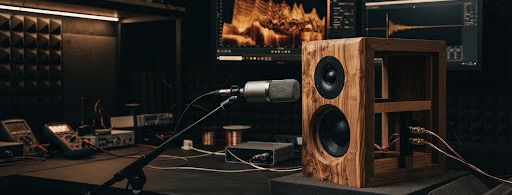
Far from any mystical or esoteric approach, the design of an H-ROW cabinet rests on the canonical equations of Neville Thiele and Richard Small. Every rehabilitated vintage driver passes through our impedance test bench to establish its exact electro-mechanical identity.
Manufacturers of the 1970s often standardized their cabinets for assembly-line or living-room-furniture constraints, trapping high-efficiency transducers in stifled sealed volumes or detuned bass-reflex boxes. By precisely measuring free-air resonance (Fs), total damping factor (Qts) and equivalent air volume compliance (Vas), we recompute the ideal acoustic tuning.
The result: a bespoke Butterworth or Bessel alignment that eliminates bass overhang, guaranteeing a clean impulse with no phase distortion.
Every H-ROW cabinet has a Helmholtz resonator tuning machined into the solid mass, computed from the transducer's own Bl factor.
Resonant Frequency (Fs)
Determines the physical low-end limit of the moving assembly. Our calculation sizes the resonator without pushing the driver beyond its linear range.
Quality Factor (Qts)
Measures the mechanical and electrical damping of the transducer. Essential to decide between a sealed enclosure or a laminar tubular port.
Equivalent Air Volume (Vas)
Represents the compliance of the air acting as a suspension spring. Each enclosure is cut to match this coefficient within 2% tolerance.
The Audiophile Standard: Analog Warmth & Surgical Neutrality
Our sonic signature seeks neither the artificial hyper-brilliance of contemporary beryllium tweeters nor the muffled coloration of 1960s receivers. We aim for the supreme balance: the organic emotion of analog timbre married to absolute time-phase fidelity.
Thanks to natural silk domes and treated cellulose cones, H-ROW transducers deliver a layering of sound planes of rare depth. Voices keep their fleshy grain and bowed strings unfold their full richness of odd harmonics.
The solid cabinetry, cleared of all internal resonance by asymmetric cross bracing, adds no box coloration. Every speaker goes through impedance and acoustic bench measurements to validate enclosure alignment, tonal balance, and phase continuity across crossover frequencies.
The Art of Wood: Mediterranean Heritage Timber
The mechanical inertia of solid timber patinated by centuries as an anti-vibration shield.
Unlike standard MDF or the injected plastics of modern industrial speakers, dense regional species have an anisotropic cellular structure that naturally absorbs rear standing waves. Each species is chosen for its specific modulus of elasticity and its internal damping coefficient.
Provençal Olive
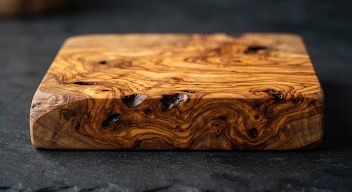
From multi-centennial trees uprooted or pruned in the olive groves of Les Baux-de-Provence. Its extremely dense interlocking grain offers unrivalled torsional rigidity and neutralizes baffle resonances.
Structural Oak
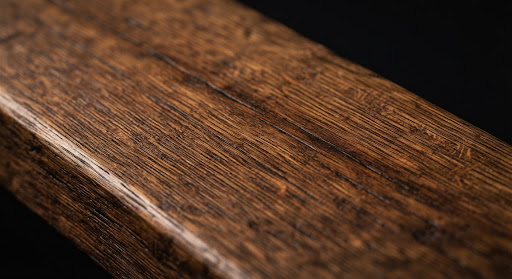
Reclaimed from old maritime warehouses and the staves of south-western wine casks. The centuries-long desiccation of its tannins gives an immutable dimensional stability, guaranteeing zero wall flexing.
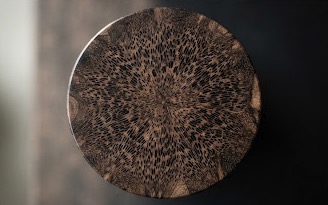
Mediterranean Palm
Upcycling of urban palm trunks from the Côte d'Azur. The orthogonal orientation of its vascular fibres creates an ideal mechanical trap against high-frequency diffraction and absorbs plinth micro-vibrations.